
Indicator lights, lenses, sunlight and wiring.
Reverses · stops short · does nothing
Garage door won’t close: causes in the order to check them
When a garage door won’t close, the way it fails tells you where to look. A door that starts down and bounces back is talking about its sensors. A door that does nothing at all is usually about power or a lock setting. A door that goes down crooked or grinds is mechanical, and that is where to stop and call.
(888) 217-1757The call reaches an independent garage door company in your area to book a visit.
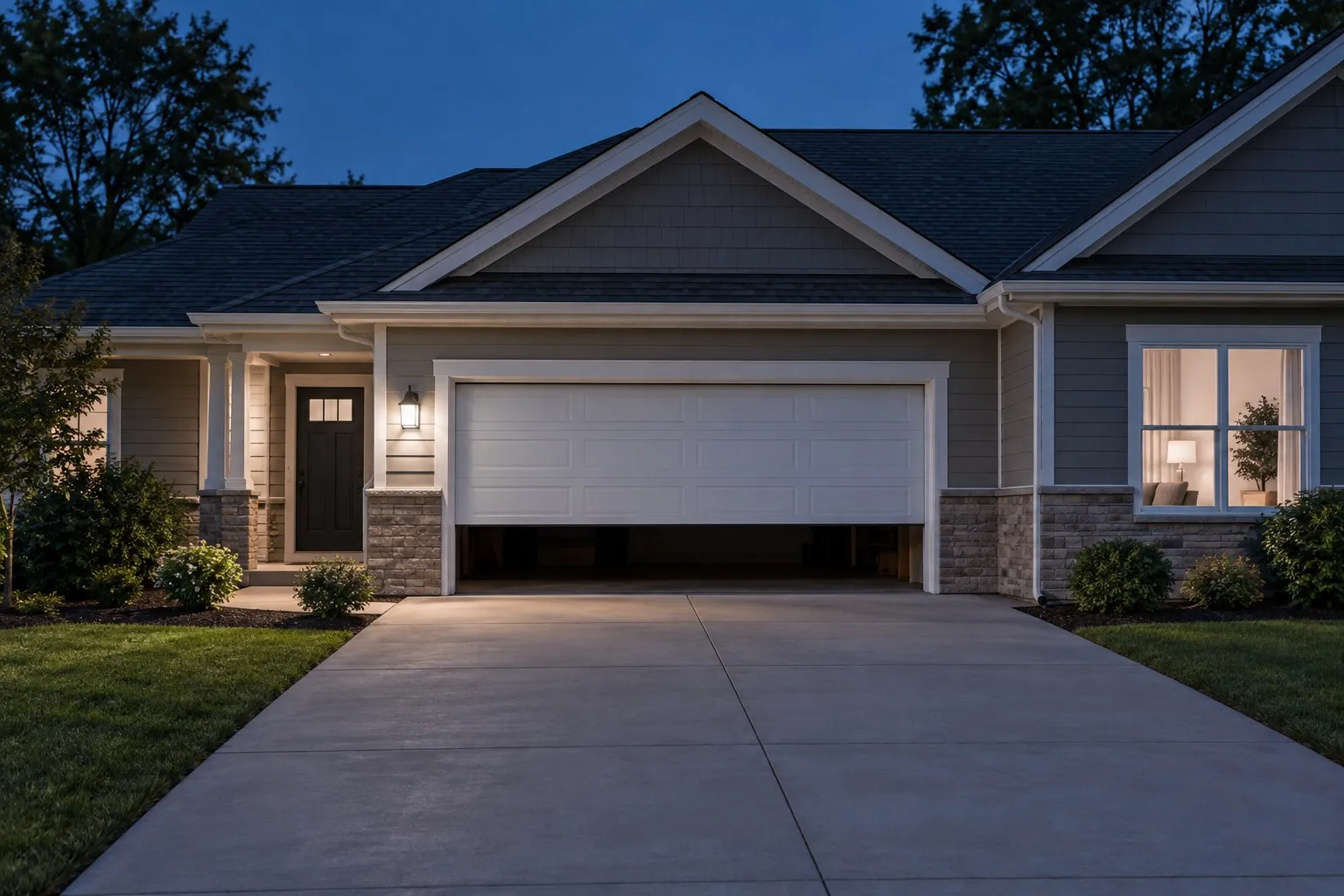
Every residential opener sold in the United States since January 1, 1993 has to reverse a closing door that meets an obstruction, under federal regulation 16 CFR Part 1211, and it checks its safety sensors on every close. That is why so many won’t-close problems are the opener doing its job: it believes something is in the way.
Match the symptom
| What the door does | Most likely | What to try |
|---|---|---|
| Starts down, reverses within a foot, opener light blinks | Safety sensors blocked, dirty or misaligned | Clear the path, wipe both lenses, check that both indicator lights are steady |
| Closes almost to the floor, then goes back up | Close limit set short, force setting, ice or debris at the threshold | Clear the floor line; the limit and force are adjusted per the opener manual |
| Nothing happens from the remote or the wall | No power, wall control in lock mode, dead remote battery | Outlet and breaker, the lock button on the wall control, a new battery |
| Motor runs, door does not move | Trolley released by the red cord, or a stripped drive gear | Re-engage the trolley per the manual; if it still spins without catching, it is a repair |
| Goes down crooked, jams or grinds | Roller out of the track, bent track, slack cable | Stop. Unplug the opener |
| Very heavy, drops fast, or a bang was heard | Broken spring | Stop. Do not lift or lower it by hand |
Garage door reverses on the way down
A door that reverses almost immediately is the most common version, and the sensors are behind most of it. The two small boxes near the floor on either side of the opening send and receive an invisible beam. Anything that breaks the beam, from a broom handle to a spider web across a lens, makes the opener reverse. Sunlight shining straight into the receiving lens can do it too, which is why some doors misbehave only in the late afternoon.
Wipe both lenses with a soft cloth, clear the floor line, and look at the small indicator lights on the sensors: on most units both glow steadily when the beam is aligned. A light that blinks or stays off points at alignment or wiring, which is covered step by step on the page about how to fix garage door sensor problems.
A door that reverses right at the floor is different. The opener sensed resistance as it reached the bottom, which usually means the close limit is set a touch too far, the threshold has ice or a bump in it, or the bottom seal has hardened. Limits and force are set from the opener, and the procedure differs by model; after any change the door must still reverse when it meets an obstruction, which a technician tests with a flat object on the floor.
Garage door won’t close all the way
A door that stops a few inches short and stays there, without reversing, has usually reached its programmed close limit early. On older doors the same gap appears when the bottom section has sagged or the tracks have spread apart at the bottom. Light under the door along one side only suggests a crooked door, which leads back to cables and rollers rather than settings.
When the problem is the door, not the opener
Disconnect the opener and the door should move by hand smoothly and stay put at waist height. If it is heavy, jerky, crooked or tries to fall, the opener was never the problem, and pressing the button again only adds strain. The usual culprits are a broken spring needing garage door spring replacement, a slipped cable, or a roller out of its track. None of those are safe to handle without winding bars and clamps.
Cold snaps add their own version. Grease on the rollers and hinges stiffens, the bottom seal freezes to the slab, and the opener reads the extra effort as an obstruction and reverses. Chip the seal loose rather than forcing the door, and if the problem returns every cold morning, a technician can set the force correctly and check whether the springs have weakened.
Do not pull the emergency release on a door that is stuck partway open with a suspected broken spring. The trolley may be the only thing holding it up.
Stuck doors: more questions
Why does my garage door close only while I hold the wall button?
Many openers allow a closing door to be driven down by holding the wall button when the safety sensors report a fault. It is a way out for the night, not a fix: the door is closing without its sensors. Get the sensors looked at before relying on it again.
My garage door won’t close all the way and leaves a gap. What is that?
Usually the close limit on the opener is set short, or the door meets resistance near the floor and the opener reads it as an obstruction. Worn weather seal, ice at the threshold and a track that pinches the bottom rollers do the same.
The door is stuck open at night. Is that worth a visit now?
An open garage is an open side of the house. If the checks on this page do not bring it down, book the visit and say the door is stuck open; that detail matters when companies schedule the day.
Where this usually leads
Gears, trolley, logic board and wall control.
A crooked door with a roller outside the channel.
One side lower than the other.
Sources checked for this page. Page last reviewed September 25, 2026.