
Gears, capacitors and boards on a unit worth keeping.
New opener · replacing an old one
Garage door opener installation, from drive type to the last test
A new opener is chosen by the door, the ceiling and how close the bedroom is, in that order. Garage door opener installation also resets the door’s safety: new sensors, new force and travel limits, and a reversal test the old unit may have been failing for years.
(888) 217-1757The call reaches an independent garage door company in your area to book a visit.
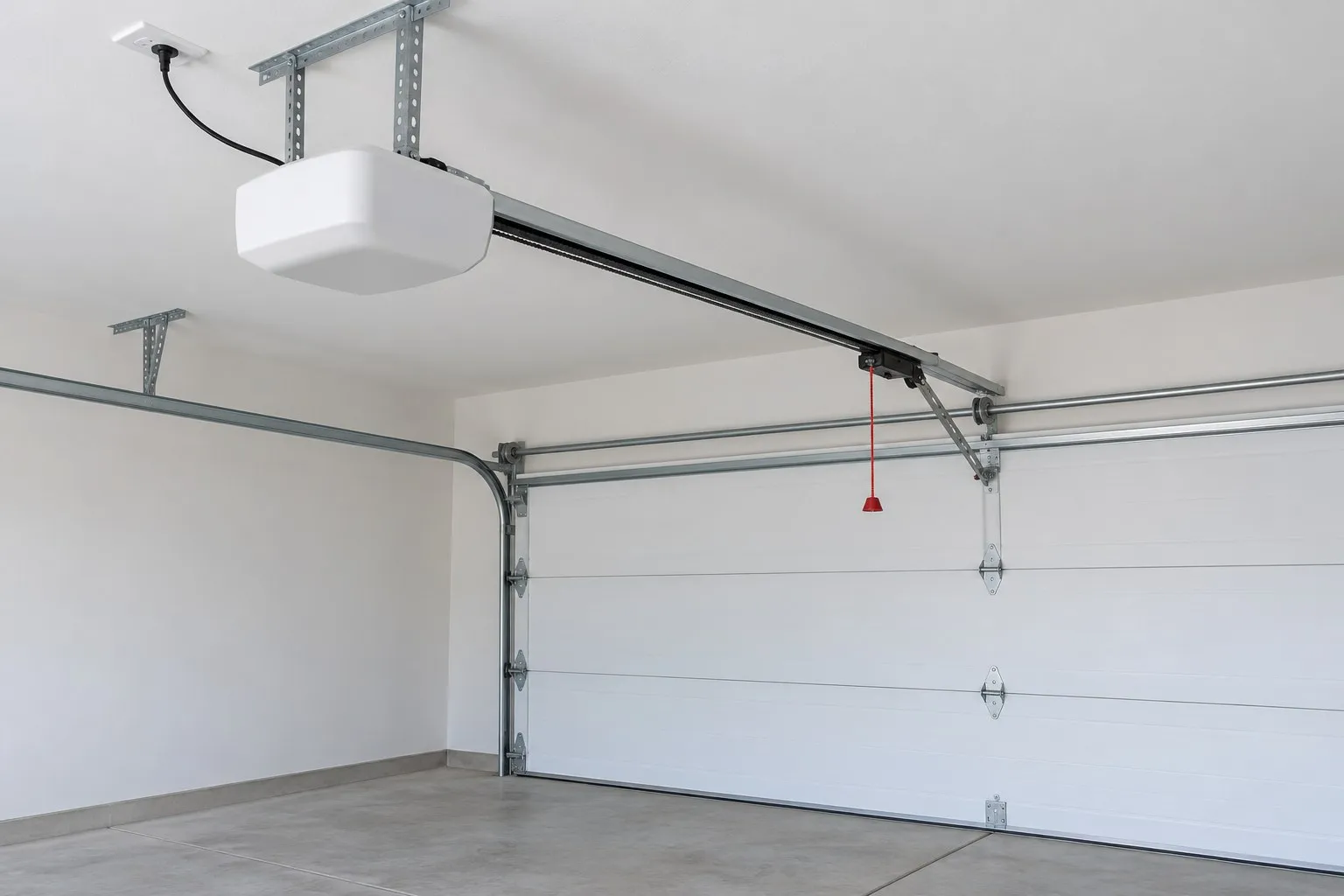
An opener does not lift a garage door. The springs do that; the opener moves a door that already weighs almost nothing when balanced. So the first step of any install is a door check: springs, cables, rollers and track. A new motor on a door with a tired spring is money spent twice.
Garage door openers by drive type
Five drives cover almost every residential install. The unit prices below are Fixr’s national ranges from January 2025, before labor.
| Drive | How it moves the door | Unit |
|---|---|---|
| Chain | Steel chain pulls the trolley along a rail. Durable and loud. | $130–$200 |
| Screw | Threaded steel rod turns inside the rail. Few parts. | $150–$250 |
| Belt | Reinforced rubber belt instead of chain. Quiet. | $170–$350 |
| Direct | The motor travels along a fixed chain in the rail. | $300–$500 |
| Wall mount (jackshaft) | Turns the torsion shaft from the side wall; no rail. | $550–$640 |
Noise is the tiebreaker most people care about. If a bedroom sits over the garage or shares a wall with it, belt and direct drives are the ones to ask about. A detached garage or a workshop can take a chain drive without anyone noticing. Lift rating is the other question: a heavy wood or insulated double door needs a stronger motor than a single steel door, and the installer sizes it to the door, not the other way round.
Wall mount garage door opener
A wall-mount unit bolts beside the door and turns the end of the torsion shaft directly. There is no rail down the middle of the ceiling, which frees space for a car lift, storage racks or a high ceiling with the door running up along it. It needs a torsion spring system, since it drives the shaft those springs sit on. It is the priciest of the five and not a fit for every door; an installer confirms the shaft, the headroom and the side room before quoting it.
Garage door opener replacement: what changes with the new unit
Anything made before January 1, 1993 predates the federal standard, 16 CFR Part 1211, that requires residential openers to reverse on contact and to monitor their sensors. If the old unit is that age, replacing it is a safety upgrade, not a style choice. Units since then may have the sensors but little else: a new opener adds rolling-code remotes, soft start and stop that go easier on the door, and in many models a battery backup and a phone app.
In California, battery backup is not optional. State law SB 969 requires residential openers sold or installed there since July 1, 2019 to have one, and a replacement door cannot be hooked up to an existing opener that lacks it. Fixr puts a battery backup add-on at $75 to $175 where it is sold separately.
The last half hour of the install
Once the unit is hung and wired, the installer sets travel limits so the door stops fully open and fully closed, then the force setting as low as will still move the door reliably. The sensors go low on each track, aimed until both indicator lights are steady. The final test is the one that matters: close the door onto an object on the floor and confirm it reverses, then break the beam with the door closing and confirm it reverses again. If either test fails, the job is not done.
Keep the old unit’s remotes out of the way until the new ones are paired, so nobody grabs the wrong one on the first evening. Ask for the manual and the programming steps for remotes to be left behind. Remotes get lost, and the next person to pair one should not have to guess the model. If the old opener was failing because of the door itself, the fixes belong in the same visit; the page on garage door opener repair lists the faults that are really door faults.
New opener: questions
Does a new opener need new sensors?
Yes. Sensors are matched to the opener that monitors them, and a new unit ships with its own pair. Reusing old sensors on a new opener is one of the ways a door ends up reversing at random.
Can an opener be installed on a door with a broken spring?
It should not be. The opener is sized to move a balanced door. Installing one on a door that is heavy because a spring is gone shortens the new opener’s life from the first day. The springs are fixed first, in the same visit if needed.
How long does garage door opener installation take?
Fixr puts professional installation at two to six hours. Replacing a like-for-like ceiling unit is at the short end; a first-time install with new wiring, or a wall-mount unit on a door that needs track changes, is at the long end.
Before and after a new opener
An opener only moves a balanced door.
Steady lights on both sides and a reversal test.
When the door is being replaced at the same time.
Sources checked for this page. Page last reviewed September 25, 2026.