
The most common reason an opener cannot lift the door.
Motor runs · door stays put
Garage door opener repair: what fails inside the motor unit
An opener is a motor, a drive, a small computer and a pair of sensors, and each fails in its own way. Garage door opener repair starts by proving the door itself is sound, because a broken spring makes a healthy opener look broken. Then it narrows to the part: gear, trolley, capacitor, board, limit settings or remote.
(888) 217-1757The call reaches an independent garage door company in your area to book a visit.
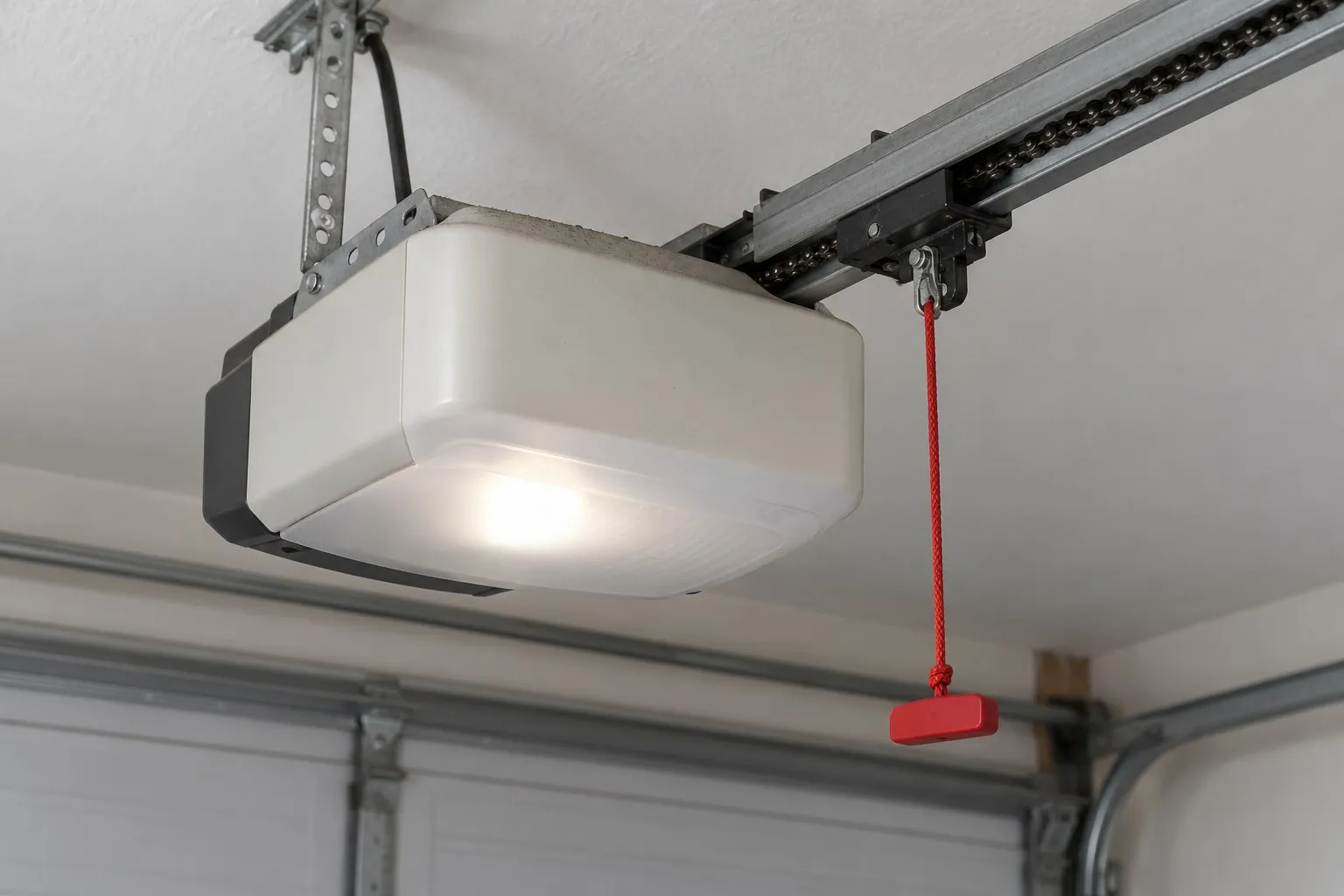
The first thing a technician does on an opener call has nothing to do with the opener. They pull the release, lift the door by hand to waist height and let go. A balanced door stays roughly where it is left. A door that drops or is too heavy to lift means the springs are gone, and no opener repair will fix that.
Garage door opener repair by symptom
Motor runs, door does not move
The motor turns but nothing reaches the door. The usual cause on chain and belt openers is the main drive gear, a plastic gear that wears its teeth off after years of work and strips completely on one bad day. The other common cause is simpler: someone pulled the red release cord, and the trolley is riding the rail without the door. Re-engaging it is in the manual; replacing a gear set is a repair visit.
Hum, click, nothing else
A motor that hums without starting often has a failed start capacitor. It can also be an opener straining against a door that will not move, which sends you back to the springs and the tracks.
Starts, stops, reverses for no visible reason
Sensors are the first suspect, then the force and travel settings, then the door itself binding somewhere in the track. Federal regulation 16 CFR 1211 requires openers made since 1993 to reverse on contact and to monitor their sensors, so an opener that reverses randomly is doing what it was designed to do with bad information. The sensor page walks through how to fix garage door sensor faults.
Dead: no light, no motor, no response
Check the outlet with a lamp, the breaker, and any GFCI outlet in the garage that may have tripped. If power is there, a surge that killed the logic board is common after thunderstorms.
Garage door opener remote and wall control
If the wall button works and the remote does not, the opener is fine. Batteries fail first; after that, remotes lose their pairing after a power event or a board change and need to be reprogrammed following the opener manual. Many wall controls have a lock or vacation button that disables all remotes, and it is easy to press by accident. A car’s built-in remote has its own pairing steps, in the car’s manual rather than the opener’s.
If neither the remote nor the wall control works, the problem is inside the head unit or its power, and that is where the job turns into a visit.
Garage door opener repair near me: repair or replace
Fixr’s January 2025 range for opener repair is $100 to $300. That makes repair the obvious choice for a gear set or a capacitor on an opener that is otherwise sound. It is less obvious for an opener that has already had its board replaced once, one whose parts are no longer made, or one old enough to predate reversing and sensors.
Location changes the math too. California law SB 969 requires residential openers sold or installed in the state since July 1, 2019 to have a battery backup, and a replacement door there cannot be connected to an existing opener without one. If the door is being replaced anyway, that settles the opener question. The options and prices for new units are on the page about garage door opener installation.
Opener faults: questions
The opener hums but nothing moves. Is it the motor?
Less often than it sounds. A hum with no movement is commonly a failed start capacitor on the motor or a door the opener cannot lift, usually because a spring has broken. Check the springs first; an opener fighting a dead weight is a symptom, not the fault.
Is it worth repairing an opener made before 1993?
Usually not. Openers made before January 1, 1993 predate the federal requirement for sensors and reversing, so they may have neither. Repairing one keeps an unsafe machine running; replacing it is the better use of the money.
The garage door opener remote stopped working. Is the opener broken?
Probably not, if the wall button still works. Replace the remote battery, check that the wall control is not in lock mode, and reprogram the remote to the opener following the steps in its manual. If the wall button fails too, the opener or its power is the problem.
Opener problems that are not the opener
Blinking lights and a door that reverses.
Limits, lock mode and the full symptom list.
Chain, belt, screw and wall-mount drives compared.
Sources checked for this page. Page last reviewed September 25, 2026.